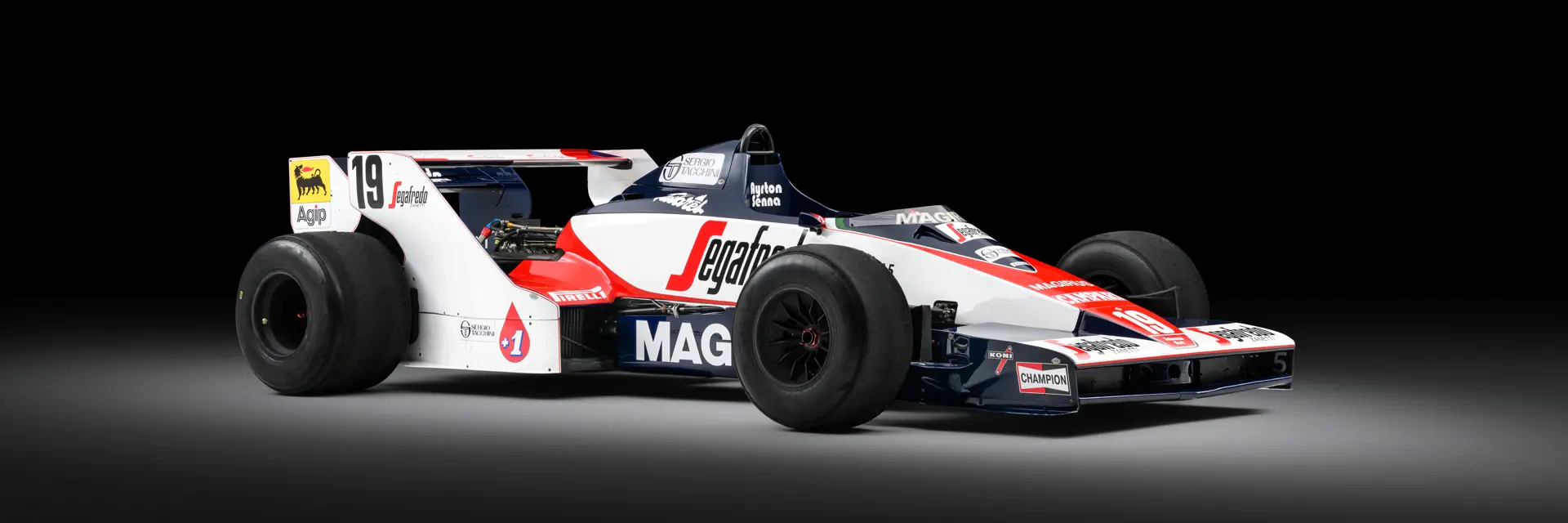
Adam Hay-Nicholls tells the story of Ayrton Senna’s Toleman TG183B-05—the car that launched one of the most remarkable careers in motorsport
Ayrton Senna won the Monaco Grand Prix a record six times, but it was 2nd place in the Principality during his maiden 1984 Formula One season which first rubber-stamped the Brazilian as an F1 star. The 24-year-old was driving for the Toleman team in a car that, in anyone else’s hands, history would have long forgotten. This was the first chapter in one of motor racing’s most dramatic and emotional storylines.
The conditions in Monaco that day were biblical. Monsoon rain was lashing the track. For the drivers, visibility was almost non-existent. Now, in dry conditions and on a regular racetrack, the Toleman-Hart could have no hope of getting anywhere close to the lap-times of Prost and Niki Lauda’s TAG-Porsche powered McLaren MP4/2s, or the Ferrari 126C4s of Michele Alboreto and Rene Arnoux and the JPS Lotus 95Ts of Elio de Angelis and Nigel Mansell, for that matter. But Monaco can be a great leveller when the heavens open. Thrust and aero are no longer king. What wins the race is precision, patience, and guts. Nowhere on the calendar does the driver make a greater difference than in a sodden, miserable Monte Carlo.
Senna qualified 13th in the dry, but when the downpour fell on Sunday something magical happened. Twelve of the 20 cars collided or spun off into retirement, including Mansell from the lead. Senna not only stayed out of trouble, he scythed through the field. By lap 10, he was up to 6th. On lap 19 he was through to 2nd after passing Lauda into Sainte Devote. And now Prost was his quarry. On each lap he took a three-second bite out of the Frenchman’s lead. Prost’s brakes kept locking due to deteriorating brake balance. By lap 31 Prost was waving his hands to the race director, Jacky Ickx, desperate to get the race red-flagged. Whether he did so out of fear of the difficult conditions or because he wanted victory called early is a matter for debate. The officials granted him his wish, and at the end of lap 32 of what should have been a scheduled distance of 76 laps the red flag was raised and Prost was declared the winner. Senna passed Prost, who was stationary on the finish line, and thought he’d won. Ayrton started waving joyously to the crowd. The Toleman team started celebrating. But the timing was backdated to the end of the lap before. The official result showed Prost had beaten Senna by 7.446 seconds. Senna was furious with Prost and the FIA, because he believed he’d have had the McLaren on a plate given another few miles.
This was a grudge Ayrton would carry into the height of his career, moving to McLaren (with Lotus as a stepping stone) in 1988 alongside Prost, and winning the first of his three Drivers’ World Championships with Ron Dennis’s team.
The Car That Started It All
The Toleman drive was Ayrton’s entry point to the pinnacle of motorsport after a sterling apprenticeship in the junior formulae, one marked by his speed and aggression. After karting, he’d moved from Sao Paulo to England in 1981 and won the British Formula Ford 1600, the British and European Formula Ford 2000, and British Formula 3 championship titles, as well as the 1993 Macau Grand Prix for F3 cars. He’d savoured victory at every level. It was just a matter of time before he did so in F1, but no one thought he’d get so close in a Toleman.
In 1983, Senna had tested for McLaren, Brabham, Williams and Toleman. McLaren and Williams, it turned out, didn’t have a spare seat for 1984—even though the Brazilian went quicker than their regular drivers. Brabham owner Bernie Ecclestone wanted to sign Senna, but his lead driver Nelson Piquet vetoed it; he didn’t wish to share the garage with a driver so prodigious. So that left Toleman, a team that had been going for five years but only three of them in F1. Senna would compete alongside Venezuelan Johnny Cecotto, a former grand prix motorcycle world champion.
Toleman was based on Station Road in Witney, Oxfordshire, and was run on a shoestring compared with the likes of McLaren, Ferrari, and Lotus. Initially they were a bit of a laughing stock, despite their success in Formula 2 (Brian Henton won the European F2 title for them in 1980). But they made monumental strides in just a few seasons. They were David versus Goliath.
The team principal was Alex Hawkridge, who’d come from working for team owner Ted Toleman’s car transportation business; trucking Fords from the Dagenham plant east of London to dealers across the country. Hawkridge hired Rory Byrne and Pat Symonds as engineers. Both would go on to win multiple championships in the 1990s and 2000s. Toleman’s 1981 and 1982 F1 cars were dire, but in 1983 they emerged as a serious competitor with the carbon-composite TG183B. The Hart turbo engine finally began to show some pace, with Derek Warwick scoring the team’s first points with a 4th-place finish at Zandvoort. They finished 9th in the 1983 constructors’ championship, a cut above the likes of Arrows and Ligier. For 1984, Warwick departed for the factory Renault team, which allowed room for Senna. Such was his reputation already, the team had pulled off a coup.
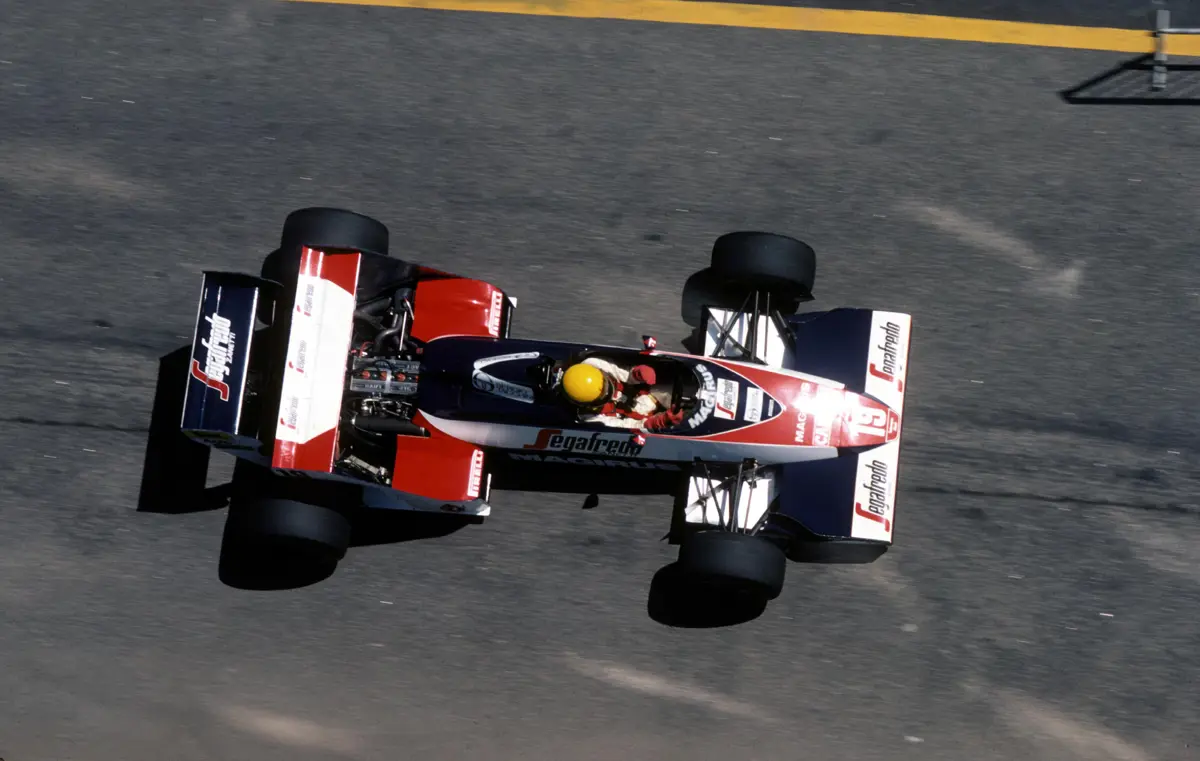
The John Gentry and Rory Byrne-penned TG183B that the team had run in 1983 was updated and would contest the first four grands prix of the 1984 season, while preparations were still underway for its successor, the TG184. This car would trade the team’s underperforming Pirelli tyres for superior Michelin rubber.
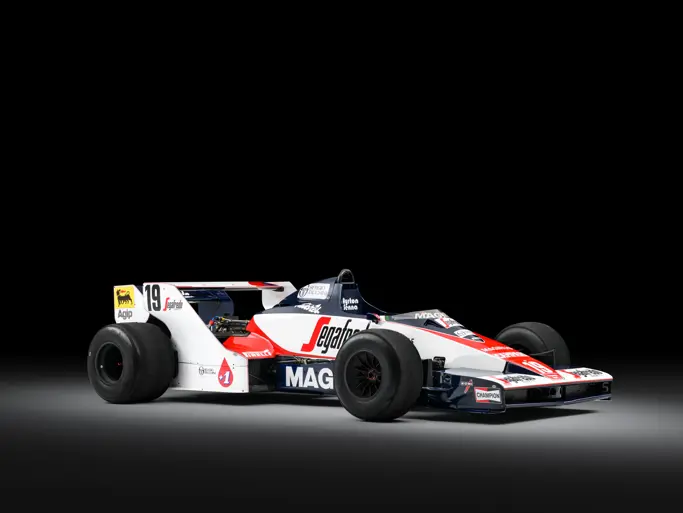
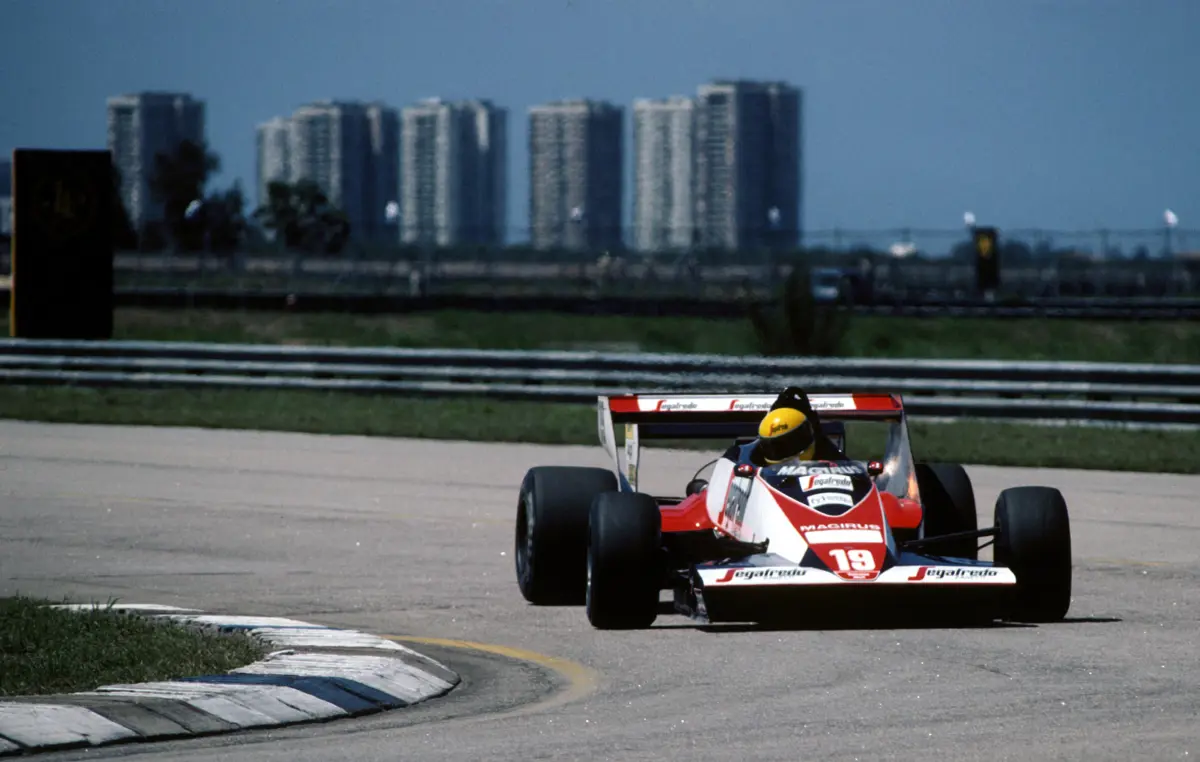
Senna was assigned chassis number TG183B-05 for his Formula One debut (a car that was raced by no one other than Senna, before or since). This would take place in his home country, making the moment all the more momentous. When he steered out of the pits in Rio de Janeiro, the Brazilian crowd saw his soon-to-be iconic yellow helmet rattling above the cockpit of an F1 car for the very first time. He qualified 16th, just ahead of Cecotto. However, he became the first retiree of the ’84 season when the Holset turbocharger feeding the 1.5-litre four-cylinder Hart blew up on lap eight.
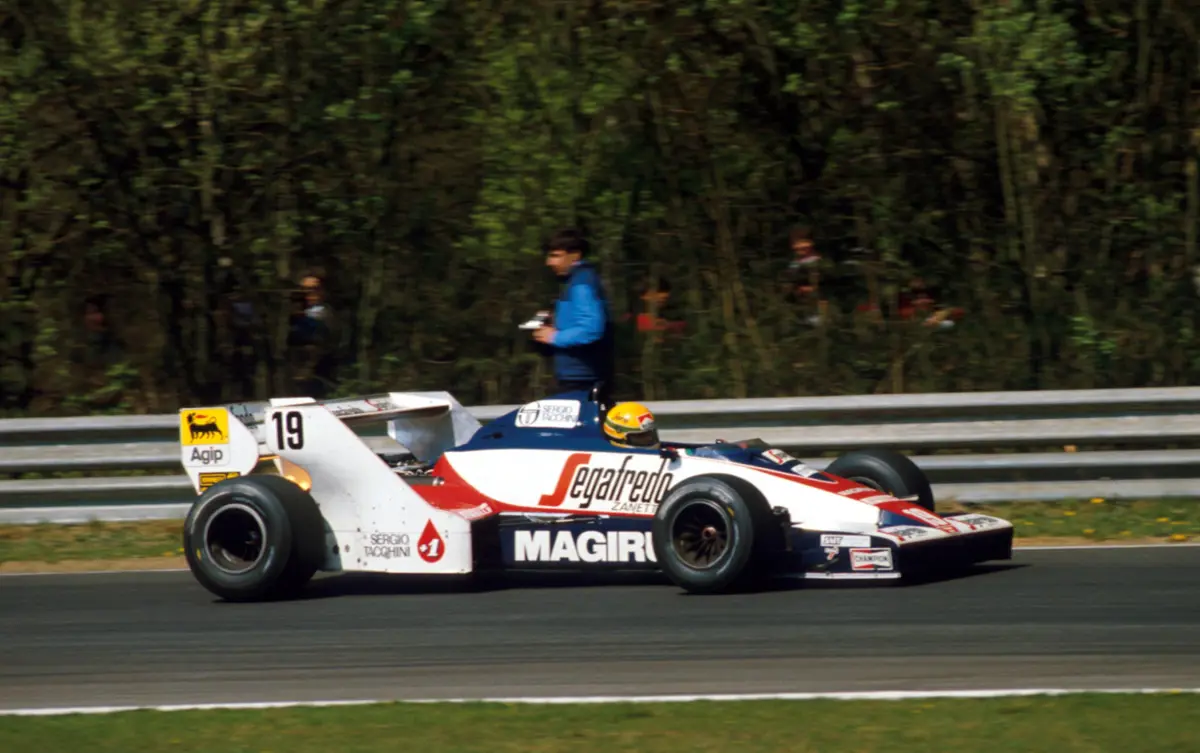
Ayrton fared better in the same chassis at the following grand prix in South Africa. Under the guidance of race engineer Pat Symonds, Senna qualified 13th on the Kyalami circuit. Despite damaging his front wing on the first lap, he climbed to 6th and with it became the top Pirelli-shod finisher that afternoon. More significantly, chassis 05 became the very car in which Senna captured his first Formula One career points—a tally that would eventually grow to 614. Chassis 05 also sped Senna in his third race, this time the Belgian Grand Prix at Zolder, where he made an impressive recovery from P19 in qualifying to bank P7 over the line. This became 6th place when Tyrrell were disqualified. A final outing in anger for chassis 05 came at Imola. Senna and Cecotto sat out practice as a war of words ensued between Toleman and their tyre supplier. Things went from bad to worse in qualifying when the Hart 415T engine developed a misfire and Senna failed to qualify for the San Marino Grand Prix—the only time Senna ever DNQ’d during his F1 career.
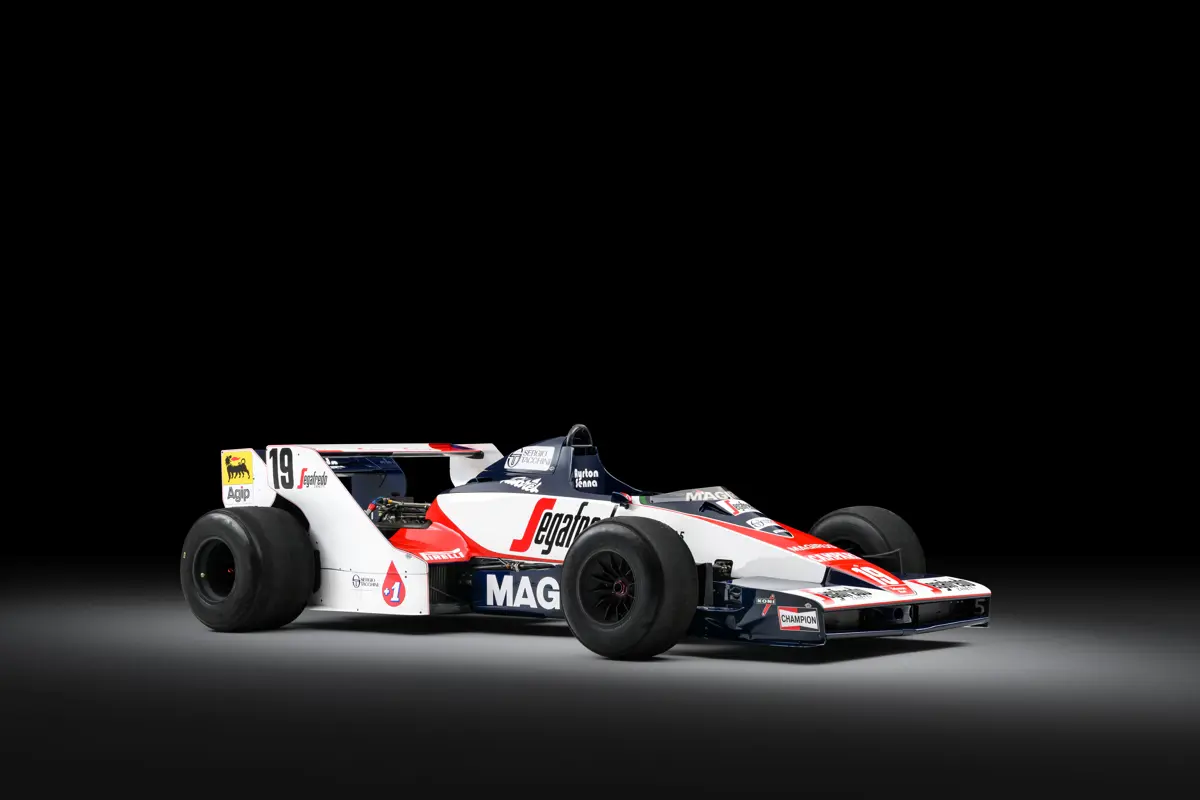
Ayrton’s first F1 car, TG183B-05, was replaced with the Michelin-shod TG184 for the next round, at Dijon, where he suffered another problem—this time the turbo. Visually, the TG184 was a very different car, even though the monocoque was the same. The unusual radiators in the front wing of the TG183B were moved to backwards to the sidepods, as is more conventional. This improved airflow, downforce and weight distribution.
Then came Monaco, where Senna put his name in dazzling lights. He may have been frustrated by the result, but boy did he set out his stall. It wasn’t his only sparkling result of the year. He went on to take 7th place in Montreal, and 3rd at both Brands Hatch and Estoril. Toleman accounted for the first three of his 80 career podia. The following year, having bought himself out of his Toleman contract to go to Team Lotus, he would return to Estoril—a very, very wet Estoril—and claim the first of his 65 pole positions and 41 grand prix victories.
Not much had been expected from Toleman in 1984, what with rookie drivers and an underpowered engine. But they made their best ever finish with 7th in the constructors’ championship that year. Losing Senna was a bane. Losing Michelin from F1 at the end of 1984 was another blow. They had no tyres for the start of the 1985 season and had to sit out the first three races. They returned in Monaco that year having been bought by the Italian fashion label United Colours of Benetton. The following season, the Toleman name disappeared and was replaced by Benetton. Byrne and Symonds stayed. A new chapter, with Flavio Briatore at the helm, Ross Brawn on the pitwall, and Michael Schumacher in the driving seat, would begin in 1991, and an impressive new factory was completed in Enstone, 10 miles north of Witney. After various changes of ownership and branding—Benetton, Renault, Lotus, Renault again—the team that was once Toleman is Alpine today.
Senna’s legacy in Formula One is unsurpassed. He is an inspiration for drivers and fans who weren’t even alive to see him race. Pierre Gasly, who is racing for Alpine, counts himself among them. Two years ago, to commemorate 40 years since Senna’s F1 debut and 30 years since the 34-year-old’s tragic death in 1994 at the wheel of a Williams, Gasly got to sample his hero’s first F1 car. Chassis TG183B-05 was prepped and ready for him at Silverstone, close to where it had been built. It had initially been retained by the Enstone team, and then sold to a buyer in the United States where it was sympathetically restored in the early 1990s. Testament to this is that the car still shows “Aryton” misspelled on the footrest, as it was in ’84. The car has returned to the UK and retains an original Hart 415T powerplant.
Gasly’s Toleman drive was broadcast on Sky Sports F1 in 2024. He didn’t treat it as a museum piece. He pounded the analogue gearbox, wrenched the wheel, and transported himself to 1984 wearing a yellow tribute helmet. The Toleman howled down the Hangar Straight—a living artifact of the moment a star was born. The moment that signalled to Alain Prost, and to the world, that Formula One would never be the same again. “I’m just speechless for the experience I just had,” Gasly told the cameras. “It was an experience I will remember for my entire life—just absolutely amazing. You’re just so much in the moment in that car. There’s a purity to driving it. It’s very emotional to drive Ayrton Senna’s first Formula One car. Even though I’m from a different generation, I like to remember this very unique champion and legend of our sport. His legacy is so huge.”
There are a number of Senna F1 cars in the world. Many have more extensive race histories, some have claimed famous victories, others wear iconic liveries. But none can match the unique significance of TG183B-05—the very car in which Ayrton Senna took his first corners, his first pit stops, and his first career points in Formula One. Chassis 05 was the machine that gave the Brazilian his first taste of the sport that he would come to dominate, both as a driver in period, and as an almost mythical legend in the years following his tragic passing. No other Grand Prix chassis is so linked to the early promise of that fledgling career than this.
RM Sotheby’s will offer TG183B chassis number 05 at its biennial Monaco auction, which takes place against a backdrop of the Grand Prix de Monaco Historique. Offered with a pre-sale estimate of €2,800,000 - €3,800,000, the red, white and blue Toleman will be hammered away to the soundtrack of Senna’s life, at a circuit that came to define his genius behind the wheel.