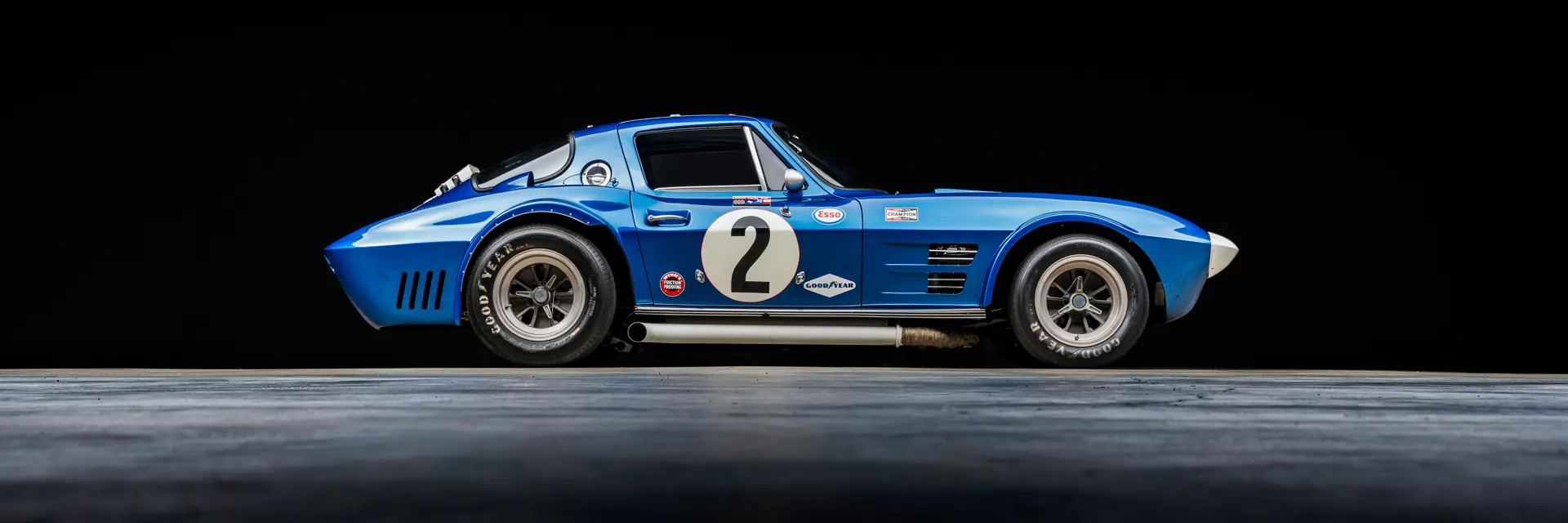
Developed in secret and banned before reaching its potential, the Corvette Grand Sport is one of the greatest American sports cars ever built, reckons Adam Hay-Nicholls.
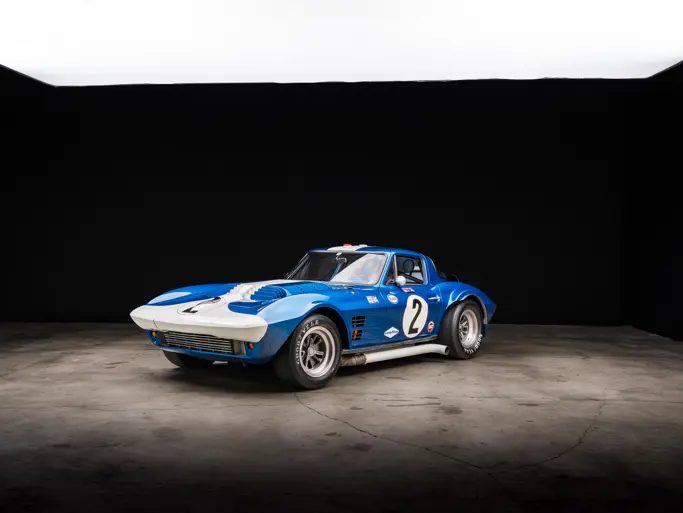
This is the tale of a car that never got its chance. It was radical, it was ready, but it was strangled in the crib by the ‘suits.’ It’s the story of the Chevrolet Corvette Grand Sport; one of the most extraordinary sports cars America has ever produced, and few people have ever heard of it. Back in the early 1960s, it was the Shelby Cobra that was the poster child for American racing muscle, but if boardroom decisions had been different the ‘Vette could’ve wiped the floor with it. At Le Mans, the movie script might have become Chevy versus Ferrari, not Ford.
The Grand Sport was Zora Arkus-Duntov’s baby. He was Chevrolet’s Director of High Performance Vehicles, and to understand the car you first have to understand the man. Z.A-D was brilliant but insubordinate, European in sensibility but American in audacity, and he was incapable of doing anything by halves. A Russian Jew, born in Brussels in 1909 and living in Berlin, where he studied engineering, he escaped to Paris just before the outbreak of World War II, married a dancer from the Folies Bergère, and joined the French Air Force aged 30. With France having fallen to the Nazis, in 1942 he hid in a Marseille brothel with his brother until he was able to reunite with his wife and secretly board a ship bound for New York.
After the war, he returned to France to race at Le Mans, and he worked in England for Allard, but his engineering career would soon see him return to the States. On viewing the Corvette concept car at the 1953 Motorama show in Manhattan, the outspoken Arkus-Duntov was inspired to write to Chief Engineer Ed Cole to say how beautiful he thought the roadster’s body, but how woeful the design was under the skin. Duntov saw everything the Corvette could be if someone with real nerve got their hands on it. Far from rejecting the criticism, he was invited to Detroit and General Motors gave him a job. Within months, he began to argue that if Chevrolet wanted to sell fast cars, Chevrolet had to win races. He ushered in the small-block Chevy V-8, the famous Duntov cam, and Rochester Ramjet fuel injection. But there was a barrier to his chequered flag dreams: GM’s refusal to race.
In 1957, the Automobile Manufacturers Association passed a rule banning factory-backed racing. The ban was partly in response to the 1955 Le Mans disaster where a Mercedes-Benz killed 83 spectators, and partly to cool down the ‘Detroit Horsepower Wars’ before the federal government stepped in. GM’s chairman pushed for it, and largely stuck to it. Ford and Chrysler found loopholes, such as setting up third-party engineering companies, and encouraging enthusiasts and private teams by publishing tuning instructions. Then in 1962 Ford withdrew from the AMA racing ban and launched itself across almost all major forms of motorsport. They also started poaching some of Chevrolet’s people.
The issue for GM was that they had 53% market share in the US, which greatly interested the Department of Justice (DOJ). In the event that its market share rose to 60%, antitrust rules would kick in and GM would be broken up. Fearing this, the management on the 14th floor wanted to reduce auto racing revenues.
All this was happening at the same time that Carroll Shelby’s AC Cobras, fitted with 7-litre (427 cu. in.) Ford V-8s, began to blaze a trail on the track. Arkus-Duntov believed he could do better. He believed he could build a car that would not only beat Ford, but Ferrari and Porsche too. He set about stripping down the new 1963 C2 Corvette, the Sting Ray, which was pretty and powerful, but too heavy for racing. The dramatically lightened machine would be called the Corvette Grand Sport, but it was nicknamed ‘Project Mongoose’ because it’s the only animal on Earth that hunts cobra snakes.
With Ford’s decision to withdraw from the racing ban, the Grand Sport programme was given the green light based on units being sold for private use, not an official works campaign. Yet anxiety about the monopoly issue persisted and the chiefs at GM were told very little. Arkus-Duntov was enabled by Chevrolet’s General Manager Semon ‘Bunkie’ Knudsen, who provided cover when needed. He gave Arkus-Duntov a hidden budget and a windowless workshop tucked away at Chevrolet’s engineering facility in Warren, Michigan.
Arkus-Duntov planned to build 125 units in order to meet the homologation requirement for international GT racing. These would be purpose-built racecars wearing a Corvette costume. The target was to contest a handful of these at Sebring and Le Mans in 1964 and to win.
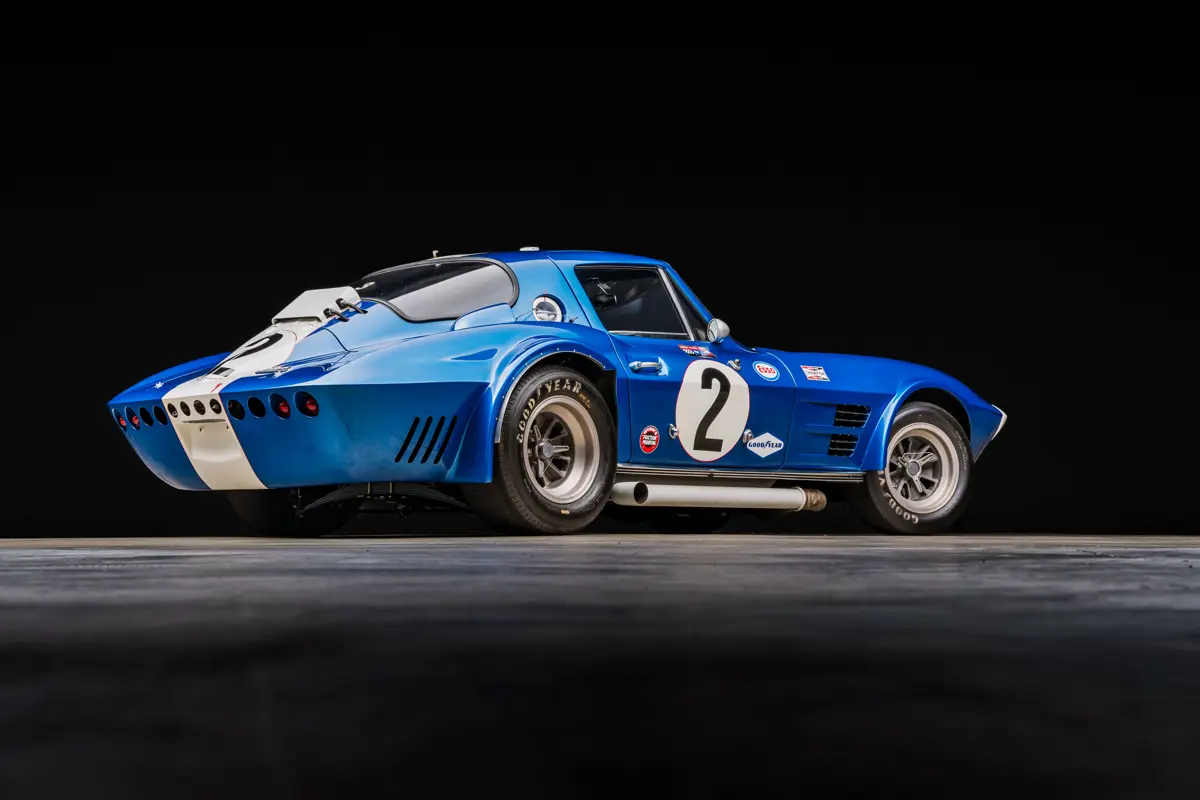
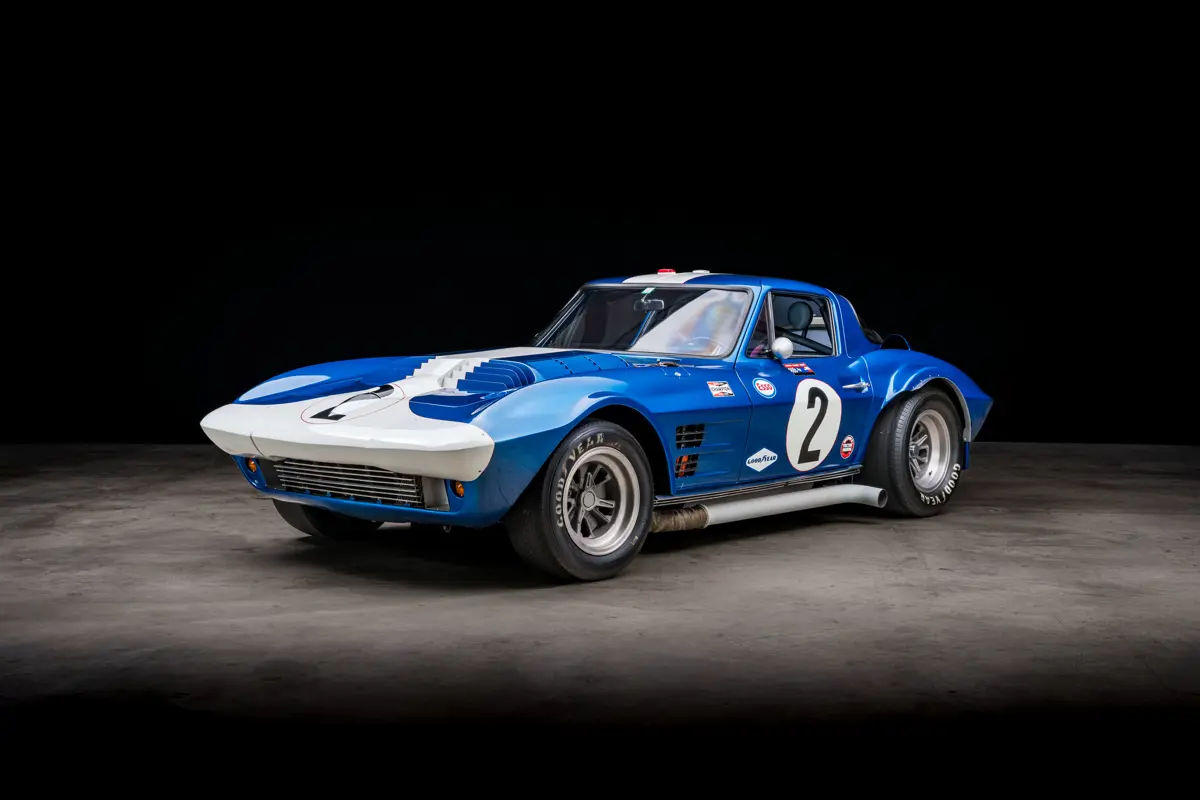
The recipe was firstly to make an aluminium version of the small-block V-8, tune it up to 550 bhp, and then set about removing all the car’s weight, Colin Chapman-style. A new stiffer ladder chassis with large diameter tubular main rails was built. All body panels were of thin fibreglass with no gel coat, and almost felt like tissue paper to the touch. The aluminium door handles were recessed into the bodywork. The headlights were hidden behind transparent plastic. However, the Grand Sport’s nose was partial to lifting at 150 mph, at which point it wouldn’t turn. To alleviate the problem, ventilation holes and gills were riddled throughout the body. FIA rules demanded the wheels be within the body, so the wheel arches were expanded, but they were right on the limit since they also served to remove air from the underbody. Girling disc brakes went on all four corners two years before disc brakes reached the production Corvette.
Oncoming airflow was used to cool the brakes via air intakes on either side of the rear window. Further lightening came through using Plexiglas, Halibrand magnesium alloy wheels, an aluminium steering box, and drilled control arms. This extreme diet saw the Grand Sport tip the scales at just 862 kilograms, whereas a standard Sting Ray was 1,451 kilograms.
The first chassis was finished in late 1962 and trucked to Sebring for secret testing, running a modified 5.4-litre (327 cu. in.) engine because the new all-aluminium block was still being worked on. It posted lap times a shade slower than the track record. Word got out.
It should have been music to the ears of General Motors’ board, but when they found out they weren’t happy. It wasn’t worth risking the wrath of the DOJ, they felt. Z.A-D was ordered to close down the project immediately. Just five cars had been built. He was told to destroy them. Not for the first time, he ignored the suits. He grudgingly agreed to down tools, but he released the five prototypes into the wild, selling them for $3,000-$6,000 each to privateers he felt could give them the lease of life they craved.
Chassis 003 went to Illinois Chevy dealer and racer Dick Doane. Chassis 004 went to Grady Davis, a Gulf Oil executive who raced. The rest of the cars passed through John Mecom Jr, a 22-year-old Houston oil heir with his own racing team who served as the frontman to keep the story going that there were no factory ties (Arkus-Duntov later recalled chassis 001 and 002 and removed the roofs, completing them as roadsters).
The Grand Sport was raced by luminous wheelmen Roger Penske, Jim Hall, and A.J. Foyt. Driving chassis 004, Dr. Dick Thompson—known as the ‘Flying Dentist’ due to his full-time profession—took the Grand Sport’s first victory in 1963 at a Sports Car Club of America race at Watkins Glen. Its true breakout moment, though, came during Nassau Speed Week in the Bahamas in December that year.
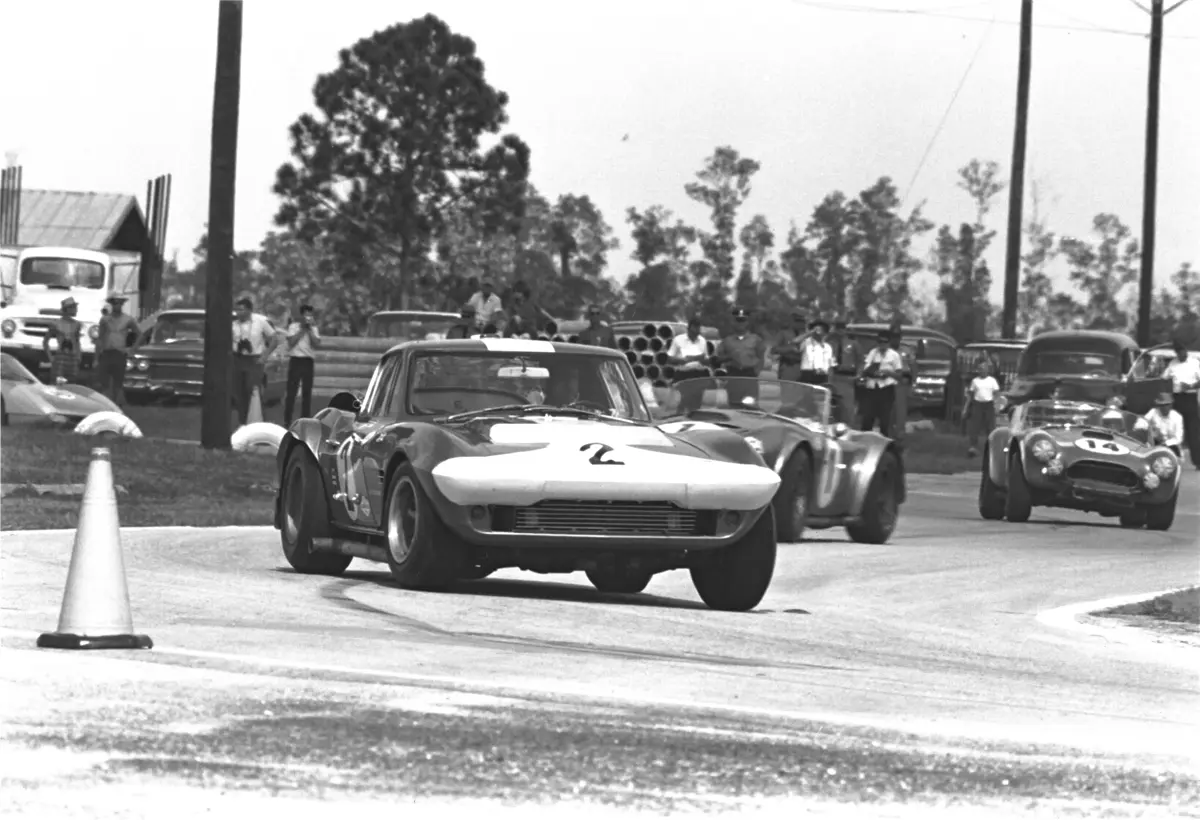
In open defiance of the GM executives, Arkus-Duntov called the Grand Sports back to Chevrolet for upgrades. He made improvements to chassis 003, 004, and 005 in secret, adding air vents and installing wider wheels that increased traction. Most importantly, he finally added the 6.2-litre (377 cu. in.) all-aluminium V-8. The three cars were shipped to Nassau and entered the race under the Mecom Racing Team banner. A group of Chevrolet engineers just happened to pick the Bahamas for a one-week vacation. Jim Hall and Dick Thompson stuck two Grand Sports on the front row for the Tourist Trophy. Both retired with overheated differentials. Fortunately, one of the holidaying Chevy engineers had some diff coolers in his suitcase that he could lend. Cooling problems fixed, the Grand Sports showed what they could really do. In the Governor’s Cup, Roger Penske finished 3rd ahead of every Cobra on the grid. In the 252-mile Nassau Trophy, Thompson finished a strong 4th. The Grand Sports were ten seconds a lap faster than the Cobras.
The New York Times reported that “the new Sting Rays […] moved much faster than any of the previous editions. General Motors has no official connection to racing in any of the divisions—stock, sports, or Indianapolis-type. Nevertheless, Ford, which is in all phases of the sport, will have to do a bit of overtime planning and thinking before the 1964 season gets into full swing.”
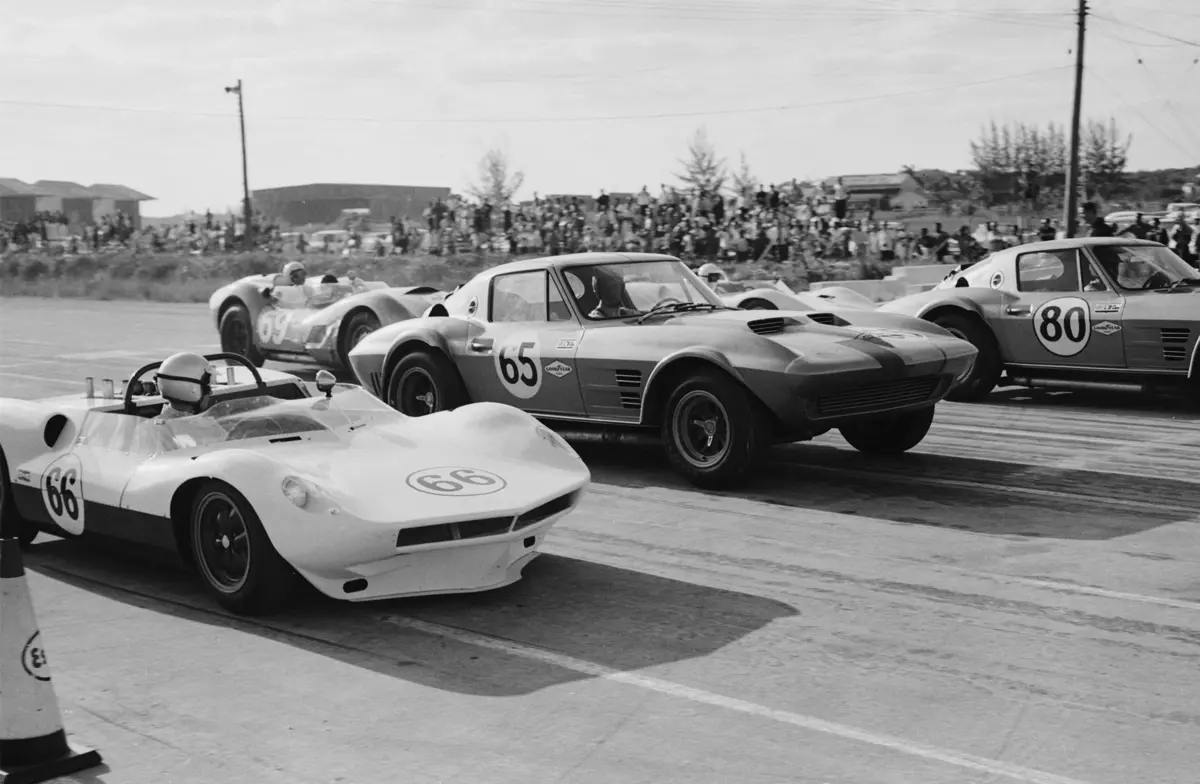
Nassau validated what Arkus-Duntov had predicted. But then he did something unwise. He forwarded the Times story with an internal memo, bragging that Ford had known about what Chevrolet was bringing to the Bahamas for over a month. GM’s chairman, Frederic Donner, saw the memo. He had not known anything about the Bahamas. He thought he’d shut the project down, and it turned out his bitter rival across town—Henry Ford II, aka ‘Hank the Deuce’—had known about this Corvette assault a month before he did. Donner’s response was final. Bunkie Knudsen was summoned to the 14th floor and given no wiggle room. Chevrolet’s role in racing was to end, completely and immediately.
Yet in private hands, the five prototype Grand Sports lived on. In 1964, Penske and Hall took chassis #005 to first place in the prototype GT class of the 12 Hours of Sebring. Penske led the opening lap, blasting past John Surtees’ Ferrari 330 P like the Formula 1 world champion was parked. At Nassau Speed Week that same year, Penske went back and won everything. Delmo Johnson, who logged more seat time in Grand Sports than almost anyone, clocked 205 mph in chassis 004 on the ’64 Carrera Panamericana.
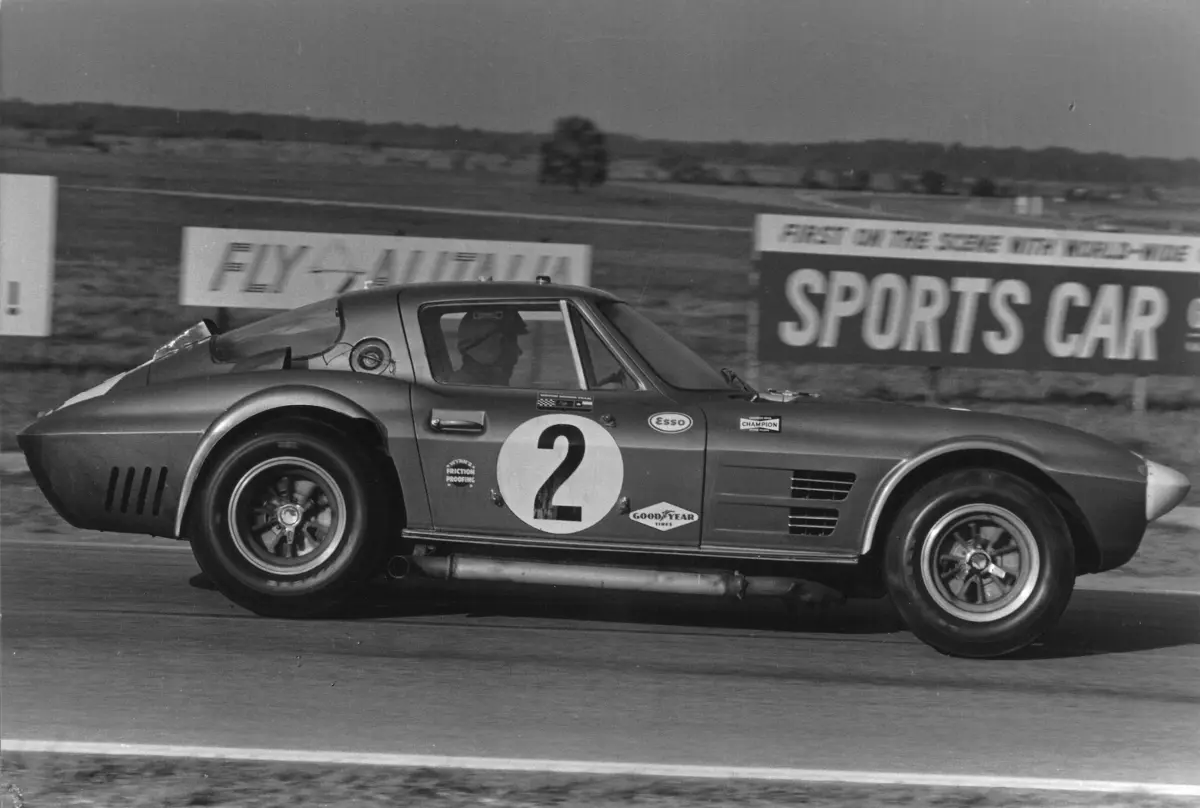
It makes you wonder, with factory support, what the Corvette could have achieved at Le Mans in the mid-60s. It could have been Zora Arkus-Duntov who upset Enzo Ferrari to take the spoils in La Sarthe, not Carroll Shelby.
The Russian-American retired from Chevrolet in 1975, but remained active in the Corvette community. He died in 1996, aged 86, in Grosse Pointe, Michigan, and his ashes are entombed at the National Corvette Museum in Bowling Green, Kentucky, which has been home to Corvette production since 1981.
Having passed up the opportunity to field a works Corvette Grand Sport team, Chevrolet resurrected the name as a muscular badge for the C4 (1996), C6 (2010), and C7 (2017) models. It’s hard not to feel a little cynical about that.
It’s almost unheard of that a Corvette Grand Sport comes to auction. The only time it’s happened previously was in 2009 when chassis 002 crossed the block at RM’s Arizona auction in Phoenix, with the value of the cars expected to have doubled in the intervening years. Grand Sports have largely traded privately, if at all, and decades can pass without one changing hands. Which makes the public offering of chassis 003 at The Monterey Auction on 13-15 August all the more significant.
Sixty-three years after they were born, all five Grand Sports exist, all in original or near-original condition. That’s partly down to those that raced them and cared for them, but it’s mostly down to a stubborn engineer who bet his career on these hand-built Corvettes. He was meant to destroy them. Instead, he just quietly moved them to where the 14th floor wouldn’t find them.