Adrian Newey’s first road car transformed Aston Martin’s ambitions. Chassis number 139 is heading to Abu Dhabi on 9 December.
The Valkyrie is Aston Martin’s north star. It is the light in the sky the rest of the company now follows. For so long, Aston Martin was defined by its front-engined GTs, their roots stretching back to the iconic DB cars of the 1950s and 1960s. But the Valkyrie single-handedly pivoted the brand almost overnight, allowing it to tackle Ferrari and McLaren head-on, gain a reputation for extreme track performance, infill the range with the mid-engined Valhalla and develop a full Le Mans race program built around a road car.
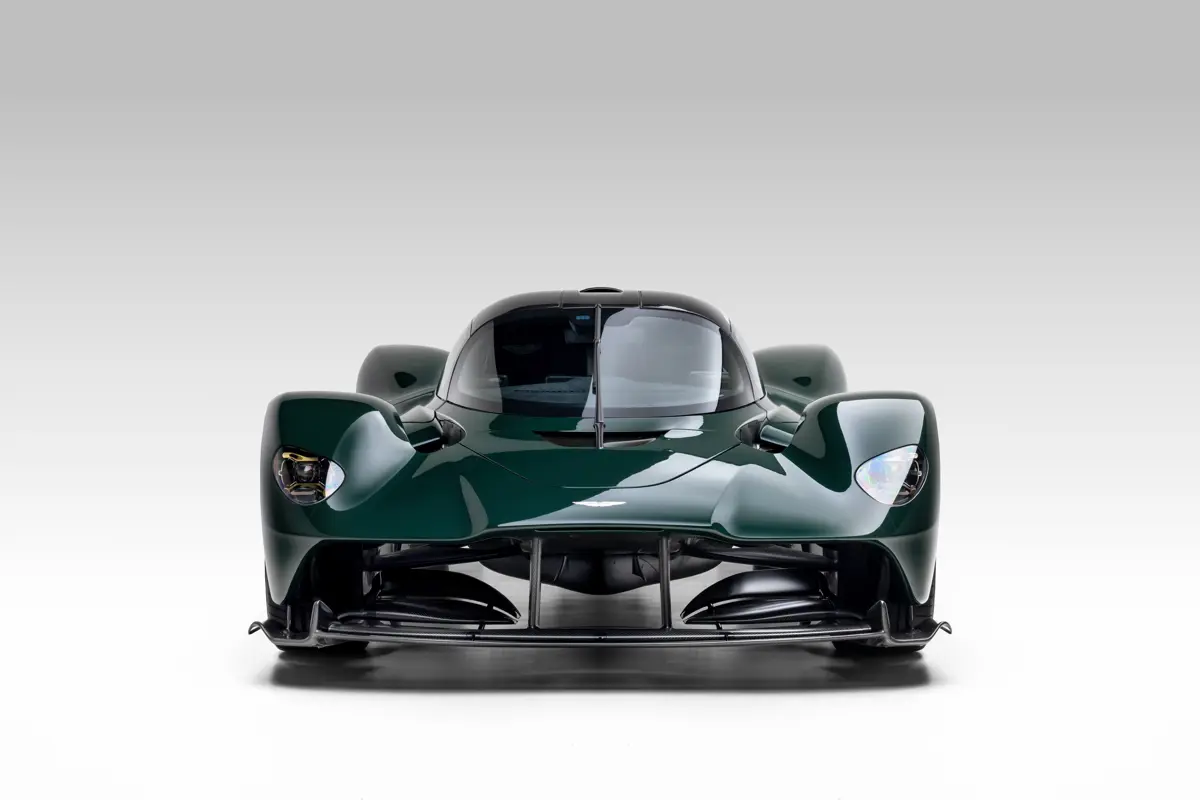
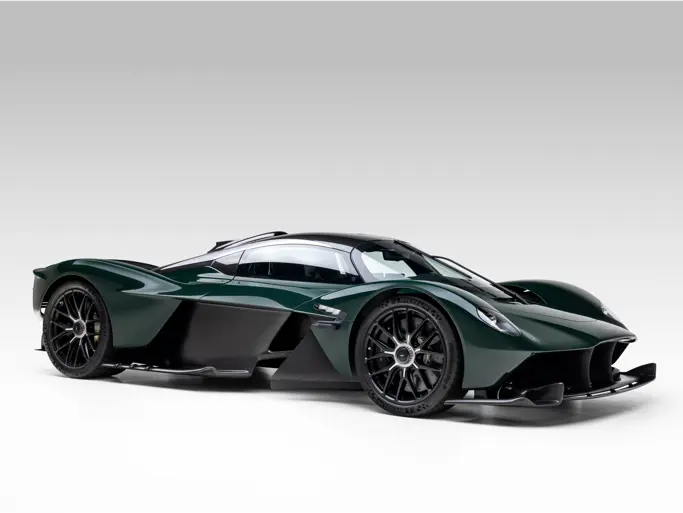
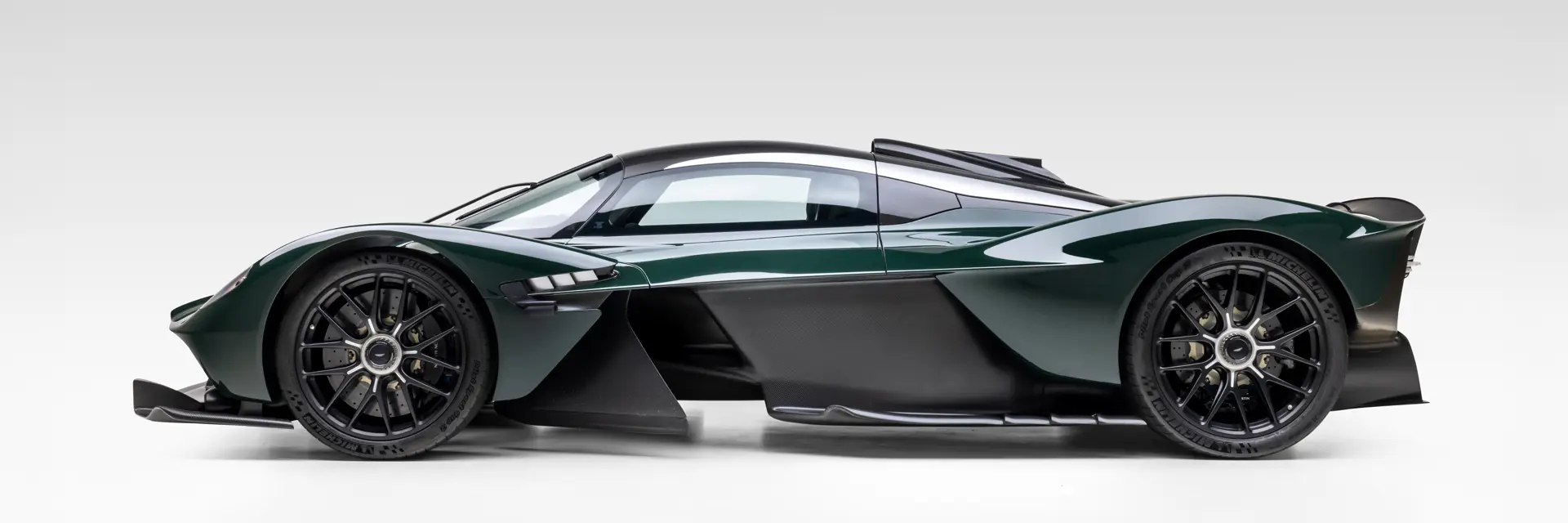
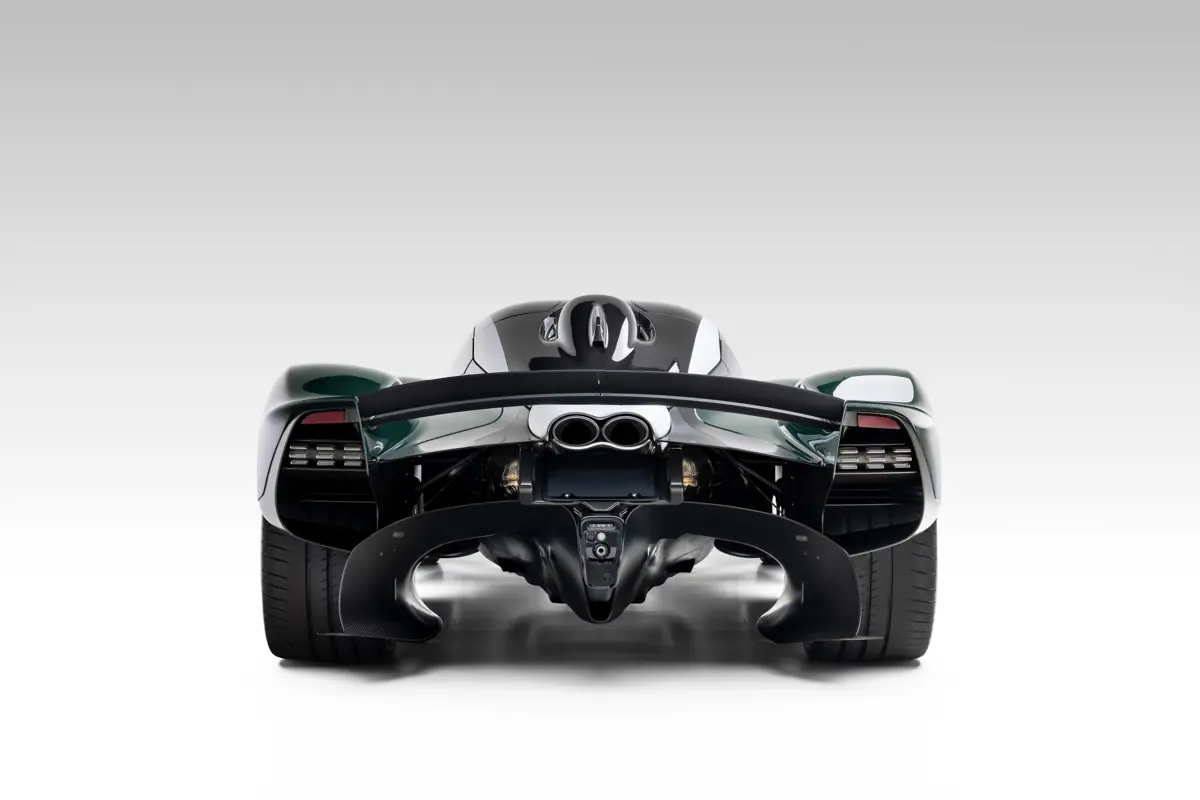
The car coming to Abu Dhabi is chassis number 139 of the 150 Valkyrie coupes originally built. Tastefully specified from the factory in British Racing Green, it combines this with silver highlighting strakes over the roofline and on the exhaust heat shielding. These are matched with Argento silver wheel centers—the solitary brightwork on the otherwise dark lower surfaces. Optional extras include a roof and engine cover finished in gloss carbon fiber, while the black magnesium performance wheels partially conceal black brake calipers.
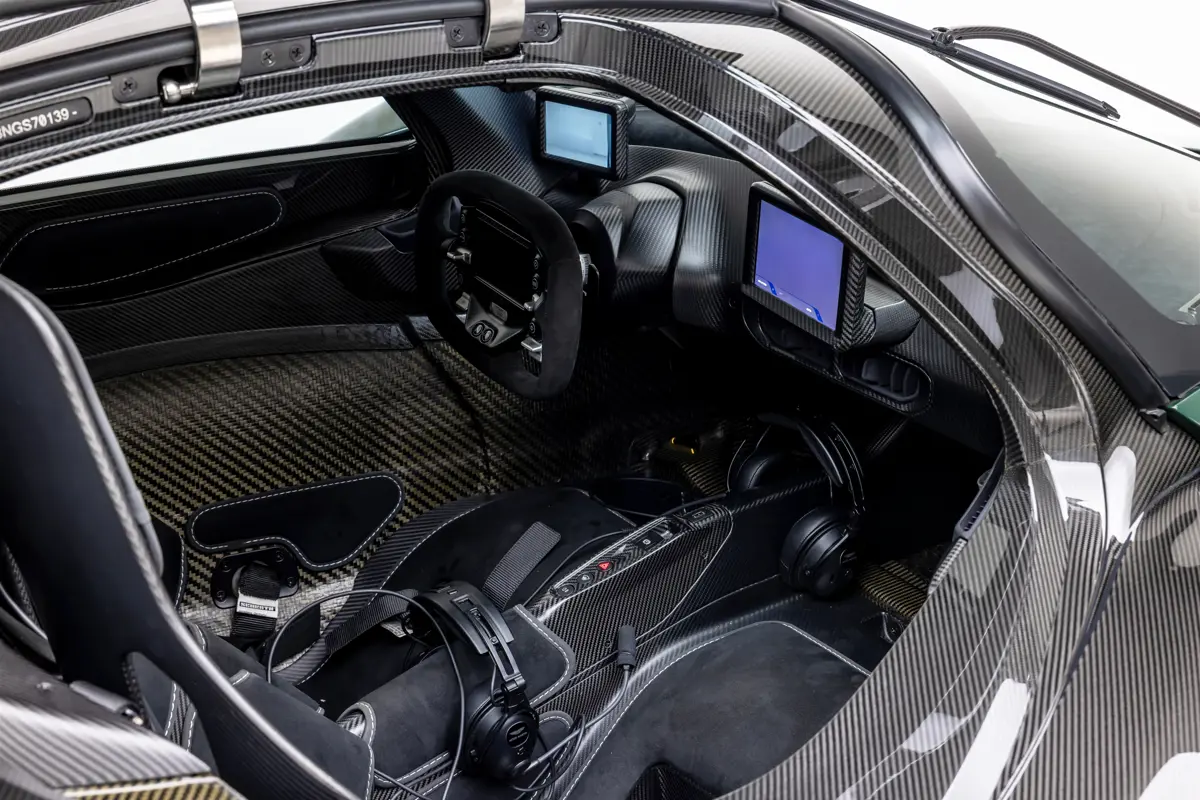
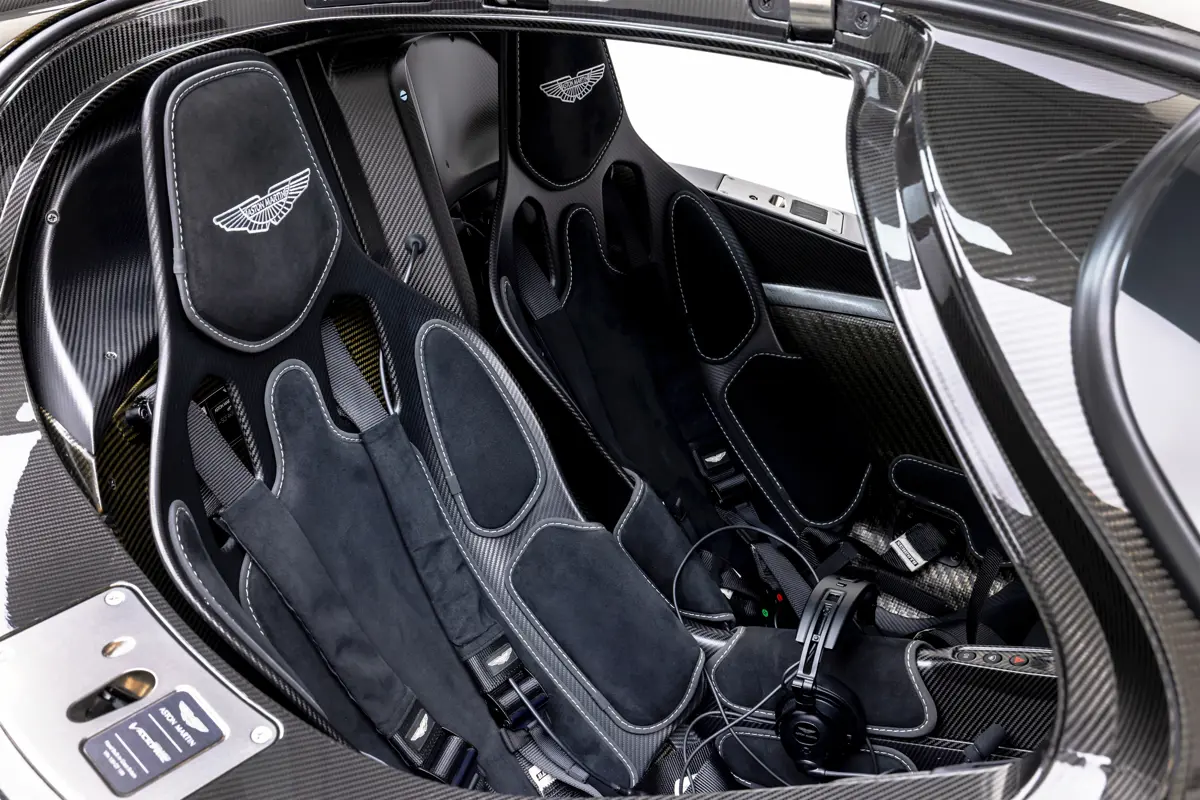
The cockpit is specified in bare carbon fiber and Alcantara, accented with silver stitching. As mentioned earlier, the optional communication system with two headphone sets is included with this car.
It was sold to Mexico as a nearly new car in August 2022, with its odometer reading just 79 miles. Retained by an automotive dealer in Florida during 2024, it then returned to Mexico, where it became a central feature of an important car collection and one of only four known Valkyries in the country. Since then, it has been used only occasionally and, at the time of cataloguing, had 553 miles showing on its odometer.
Valkyrie: A History
Very few cars in history have had a greater influence and impact on their brand than the Valkyrie. Even fewer have had such an influence on their rivals that they have largely redefined the class in which they compete. No other hypercar is more single-minded, more focused, or more radically designed and engineered than this one. We’d seen the shift towards aerodynamics as the next big battleground, and we’d seen the emergence of cars such as the McLaren Senna, with downforce becoming a performance metric. But from the moment the Valkyrie was announced in 2016, everything else lived in its shadow. And has done ever since.
It was designed by the greatest F1 designer of this—or any other—era: Adrian Newey. By most measures, and despite not being a driver, Newey is the most successful person ever to have competed in F1. His cars have won 14 Drivers’ Championships and 12 Constructors’ Championships. With little left to prove and a nagging desire to design a road car, a partnership was struck between Red Bull F1 (Newey’s employer) and the team’s then-sponsor, Aston Martin, in 2014. Newey’s background told you this wouldn’t be a regular road car, that it would inevitably lean towards his passion and expertise on the track. But it went so much further than that, because it would have nothing in common with any other Aston Martin. Not even Aston’s famous V-12 would be carried over. Because the aerodynamics came first. And last. They were everything.
Look at a Valkyrie from behind and you start to understand why. It’s so porous, so empty underneath that it seems to hover above the ground. Giant Venturi tunnels dominate, separating the wheels from the central tub. You get the impression that if the top layer were removed, you’d be left with an open-wheel racing car. That’s not an inaccurate impression, as the rest of the design follows a motorsport template, too: inboard suspension, a 120-bar carbon-ceramic brake system and a carbon tub with the engine bolted directly to the back of it to form a structural part of the car.
But what engine if not Aston’s own V-12? An exotic car demanded a much more exotic solution. To fit Newey’s brief and interrupt the airflow as little as possible, the engine had to be slender. It also had to be light, naturally aspirated and very, very powerful. Step forward another legendary F1 firm, engine builder Cosworth. The result was a masterpiece: a narrow-angle, 65-degree, 6.5-liter V-12 that weighed just 206kg yet developed 1,000bhp. It achieves that by revving to 11,100rpm.
Maximum power stands at 1,160bhp, pushing along a dry weight of 1,270kg—a near-1:1 power-to-weight ratio that enables massive acceleration. Despite having to use electric power to pull away from a standstill (and to go backwards, as there’s no reverse gear in the transmission), the Valkyrie is still capable of covering the 0–62mph sprint in 2.8 seconds and 0–100mph in 4.2 seconds. Top speed stands at 224mph.
And yet it has no giant rear wing. Instead of using huge upper-surface wings to push the car into the road, it uses those low-pressure Venturi tunnels to suck itself down. This low-drag, high-downforce concept is not only highly innovative in the hypercar world, but also ensures immense stability and vivid high-speed acceleration. On many tracks, it is faster down the main straight than an F1 car.
The Aston Martin Valkyrie is one of the most influential and important collector cars of the 21st century. Its position as Adrian Newey’s first road car gives it a cachet that can never be repeated, but beyond that, it’s the uncompromising approach to every single aspect of the car’s design, engineering, performance, and execution that makes it arguably the most single-minded hypercar there’s ever been. There has never been a car with a more tangible link to the core of Formula 1 than this.