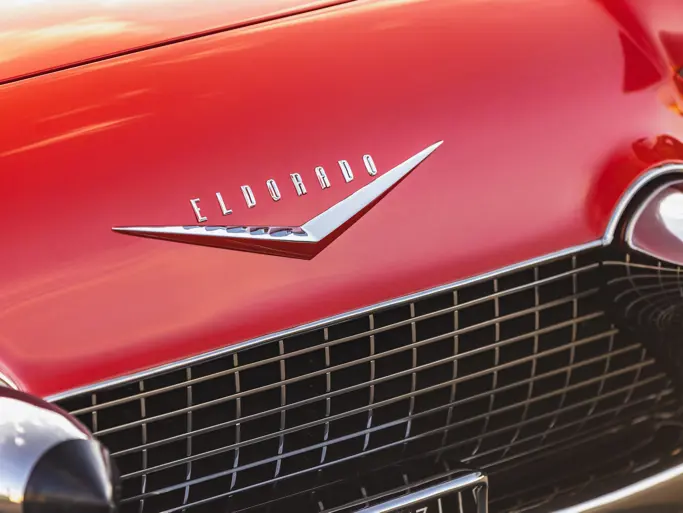
From the restrained 1954 car to the towering fins of 1959, the Eldorado moved the fifties at Detroit Speed.
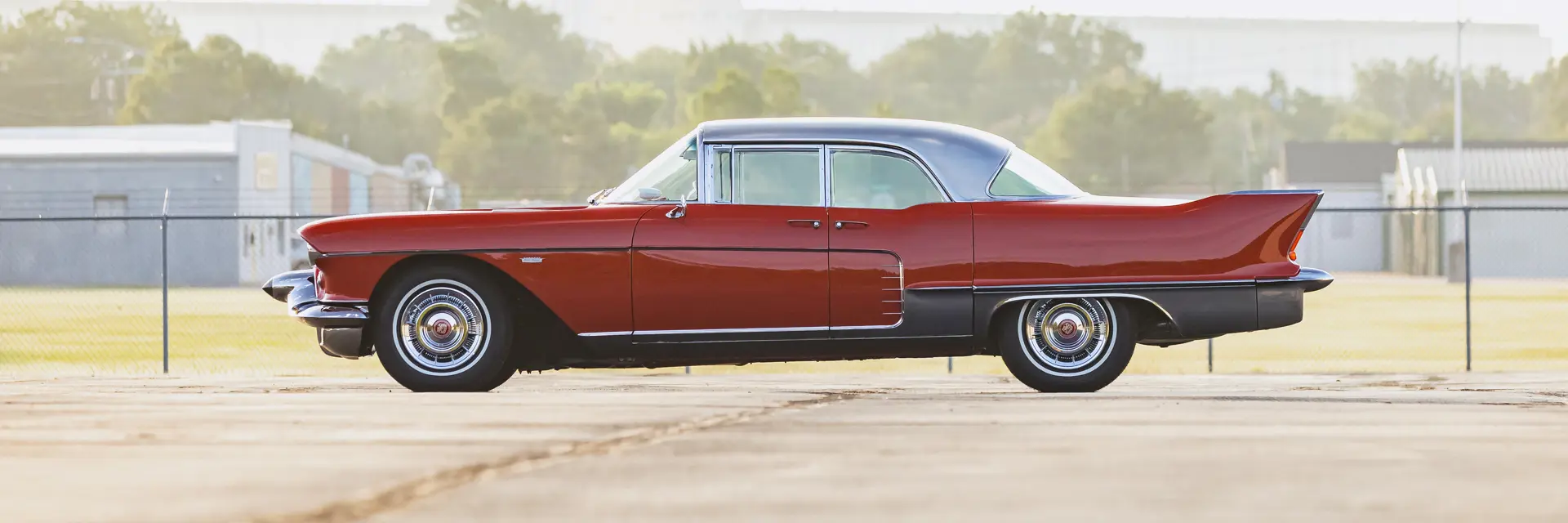
Put a 1954 Cadillac Eldorado beside a 1959 Biarritz and the rate of change is astounding. The earlier car is big, expensive, and decorated with enough chrome to keep a polishing cloth busy for a week, but its proportions still belong to the early 1950s. Five years later, Cadillac had produced something lower, wider, and far more outrageous, with a windscreen seemingly borrowed from a jet canopy and rear fins tall enough to become shorthand for an entire period of American design.
The Eldorados offered at RM Sotheby’s Hershey sale cover much of that transformation, from the 1954 Series 62 Eldorado through the Biarritz and Seville of 1956, the Eldorado Brougham and the 1959 Biarritz. They also show how quickly the Eldorado’s role changed; it began as a limited-production derivative of a show car and soon became Cadillac’s preferred place to try new styling and engineering ideas.
Even the name came from a suitably 1950s piece of corporate theatre. Cadillac ran an internal competition to name a special convertible prepared for its Golden Anniversary displays in 1952, with merchandising employee Mary-Ann Zukosky’s ‘Eldorado’ chosen for the car. The name was well picked. El Dorado was the legendary city of gold, so there was no great mystery about what Cadillac was trying to suggest with it.
The production version arrived for 1953. Based on the Series 62 convertible and using Cadillac’s 331 cubic-inch overhead-valve V-8, it gained a dramatically dipped door line, a hood that folded beneath a flush metal cover and a windscreen that wrapped into the sides of the body. Cadillac had spent years under Harley Earl using show cars to test future production ideas; here, much of the theatre actually reached the showroom.
At $7,750, it was close to twice the price of a regular Series 62 convertible, and just 532 were built. Buyers received power steering, power brakes, power windows and seat, leather upholstery, and chrome wire wheels as standard.
For 1954, Cadillac made the formula easier to build and, at $5,738, easier to buy. The Hershey example is one of 2,150 produced that year. The Eldorado now shared more bodywork with the Series 62 convertible, while retaining special trim, gold-colored badging and chrome wire wheels. Its 331 V-8 produced 230 horsepower. More tellingly, the wraparound windscreen that made the 1953 car look so startling was now spreading across Cadillac’s range.
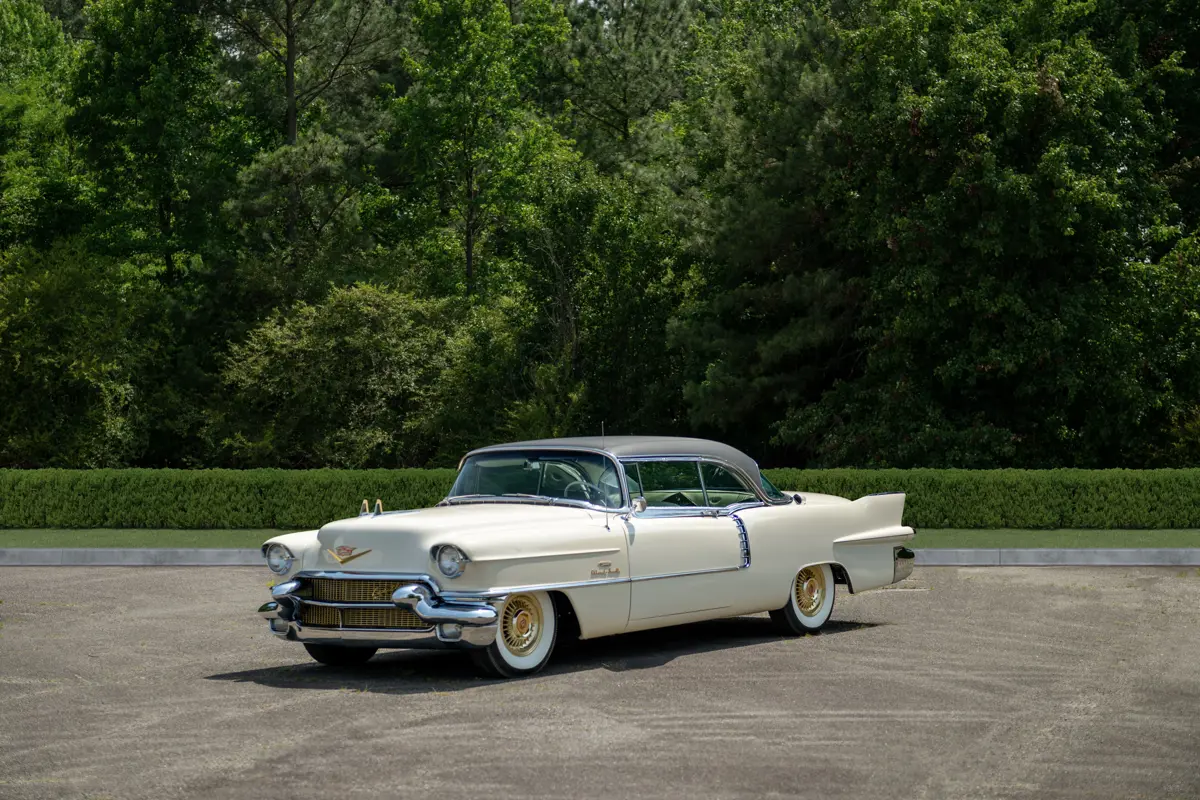
Cadillac gave it more visual separation again for 1955. Rear-wheel skirts disappeared, the fins became sharper, and the V-8 gained twin four-barrel carburetors for 270 horsepower. A year later, displacement rose to 365 cubic inches and output to 305 horsepower. Eldorado also became a range; the convertible was renamed Biarritz and a new hardtop coupe became Seville, both represented at Hershey.
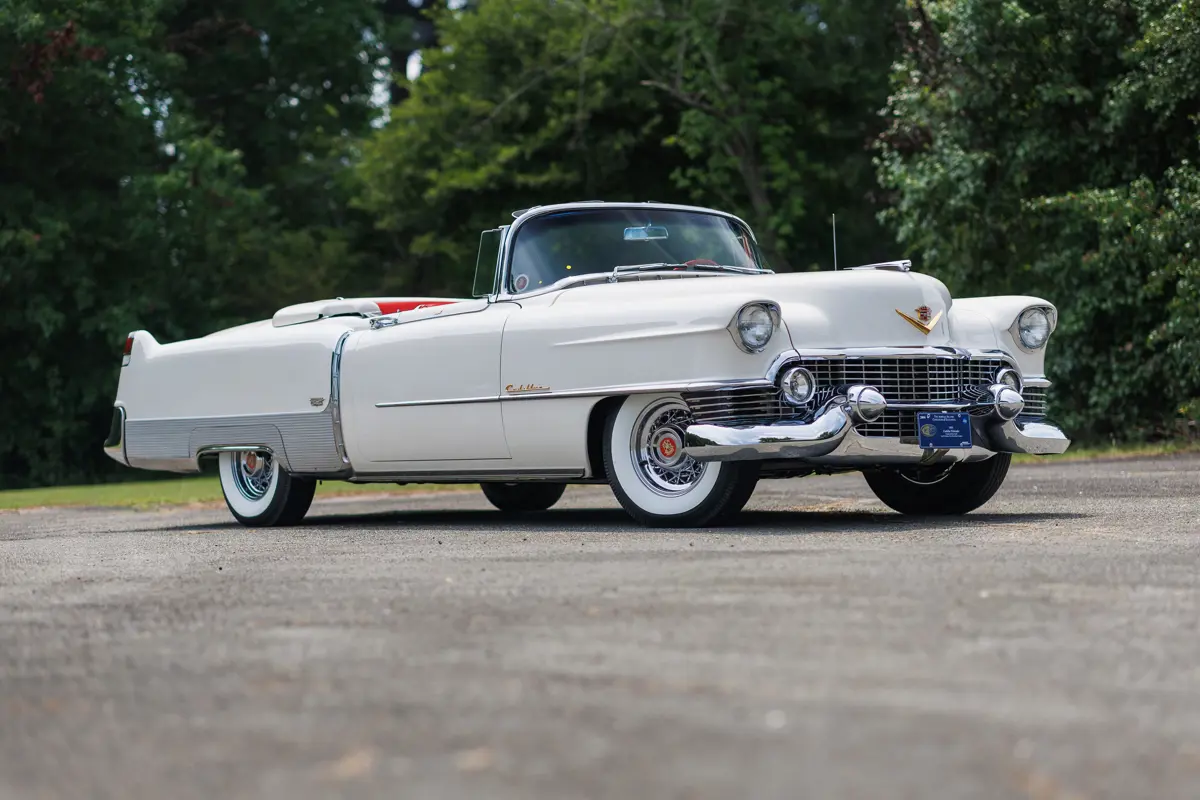
There is a pleasingly transparent sort of aspiration to those names. Biarritz and Seville sounded exotic from Detroit, just as Riviera did at Buick. The hardware was less frivolous: power steering and brakes, power windows, and Hydra-Matic transmission were standard, while Eldorados retained the hotter twin-carburetor engine beneath their gold ‘batwing’ air cleaner.
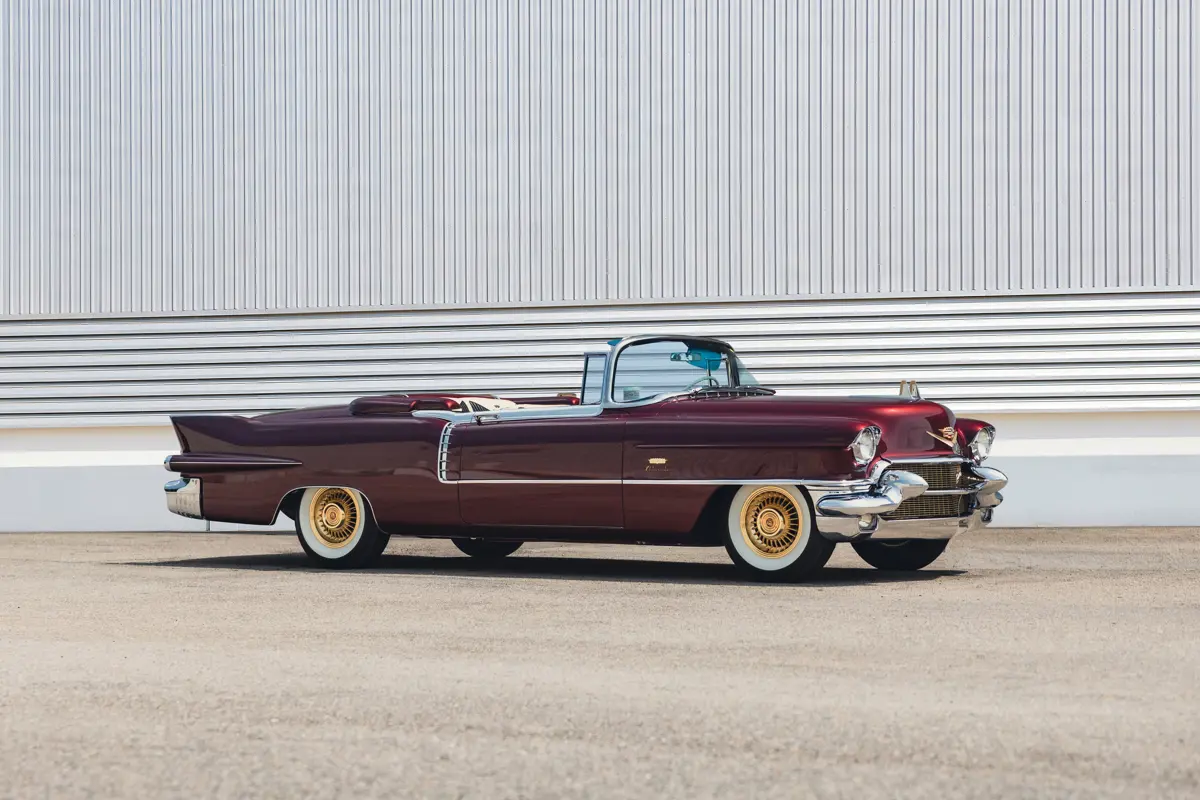
Cadillac was meanwhile working on something much more ambitious. The Eldorado Brougham appeared as a Motorama dream car in 1955, with a pillarless four-door body, center-opening doors, quad headlamps, and a brushed-metal roof. The unique 1956 Eldorado Brougham Town Car at Hershey developed the idea further. Known internally as XP-48, it was designed by 19-year-old Robert Cumberford under Herb Cadeau and Harley Earl, with hand-laid fiberglass bodywork and a chauffeur-driven layout very different from the production Brougham that followed.
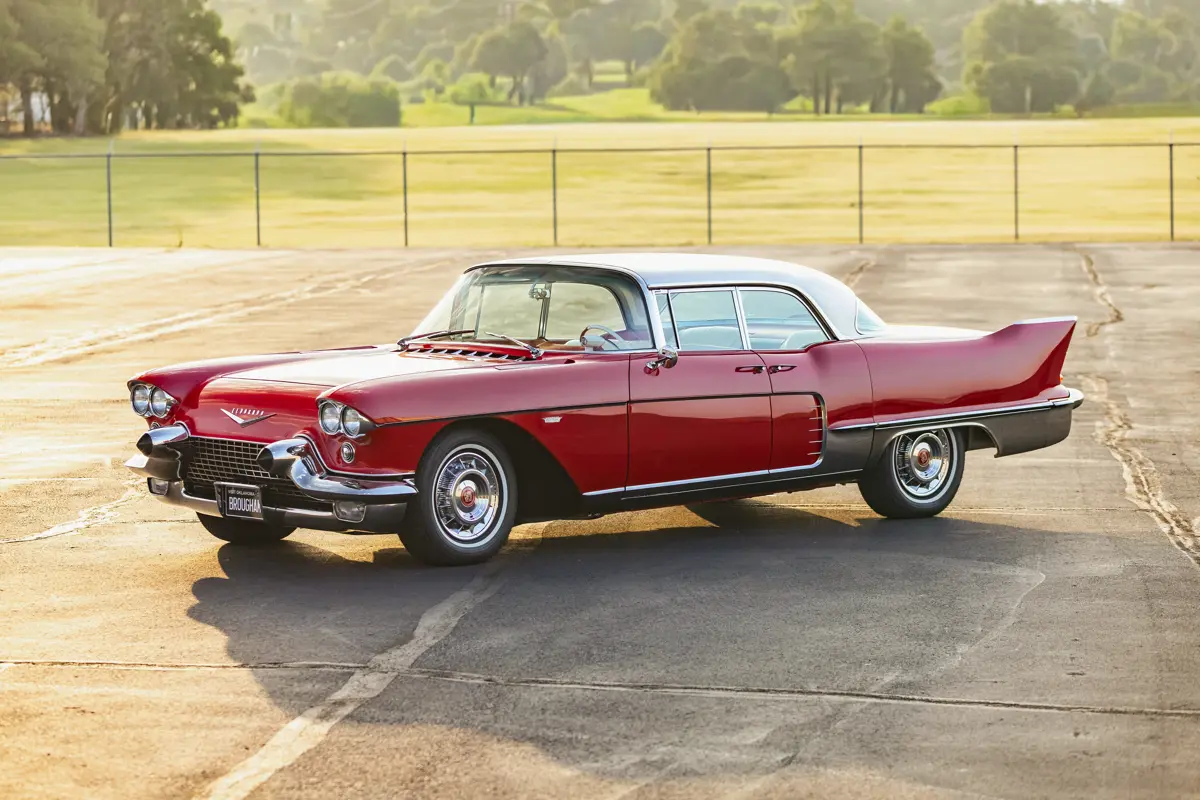
When that production car arrived for 1957, Cadillac had clearly given its accountants a difficult afternoon. The Eldorado Brougham cost $13,074, nearly twice the price of a Biarritz, and only 400 were built in its first year. Its specification included self-leveling air suspension, forged aluminum wheels, a memory driver’s seat, automatic boot release, air conditioning, cruise control, and a transistorized radio. A brushed stainless-steel roof and center-opening rear doors completed the effect.
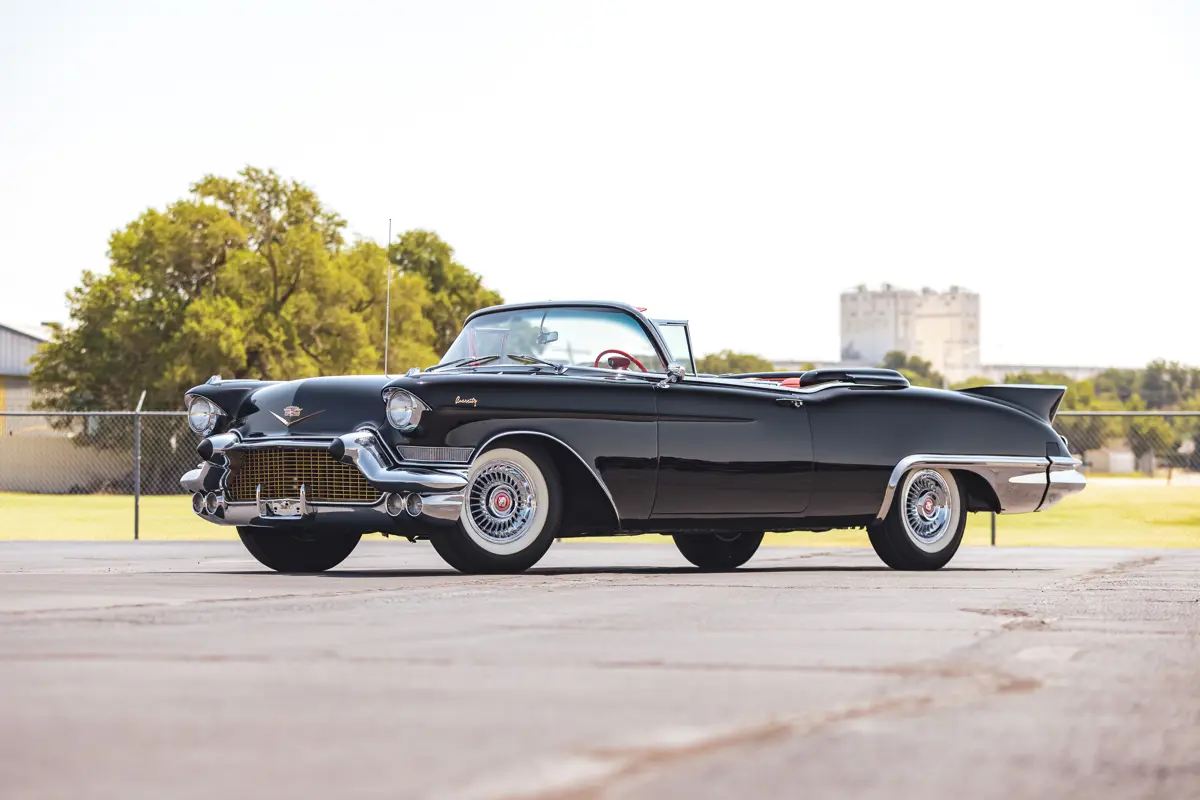
The engineering went well beyond the toys. Cadillac developed the air suspension to maintain a constant ride height while improving ride and handling, and the 365 cubic-inch V-8 produced 325 horsepower. The 1957 Biarritz and Seville received the same output, plus new X-frame construction that allowed a lower body and leaner stance.
Cadillac’s designers had also seen how rapidly the styling contest was moving. GM personnel were given an early look at Virgil Exner’s dramatically lower 1957 Chrysler products during 1956, prompting considerable unease inside General Motors and helping force a rethink of its forthcoming designs.
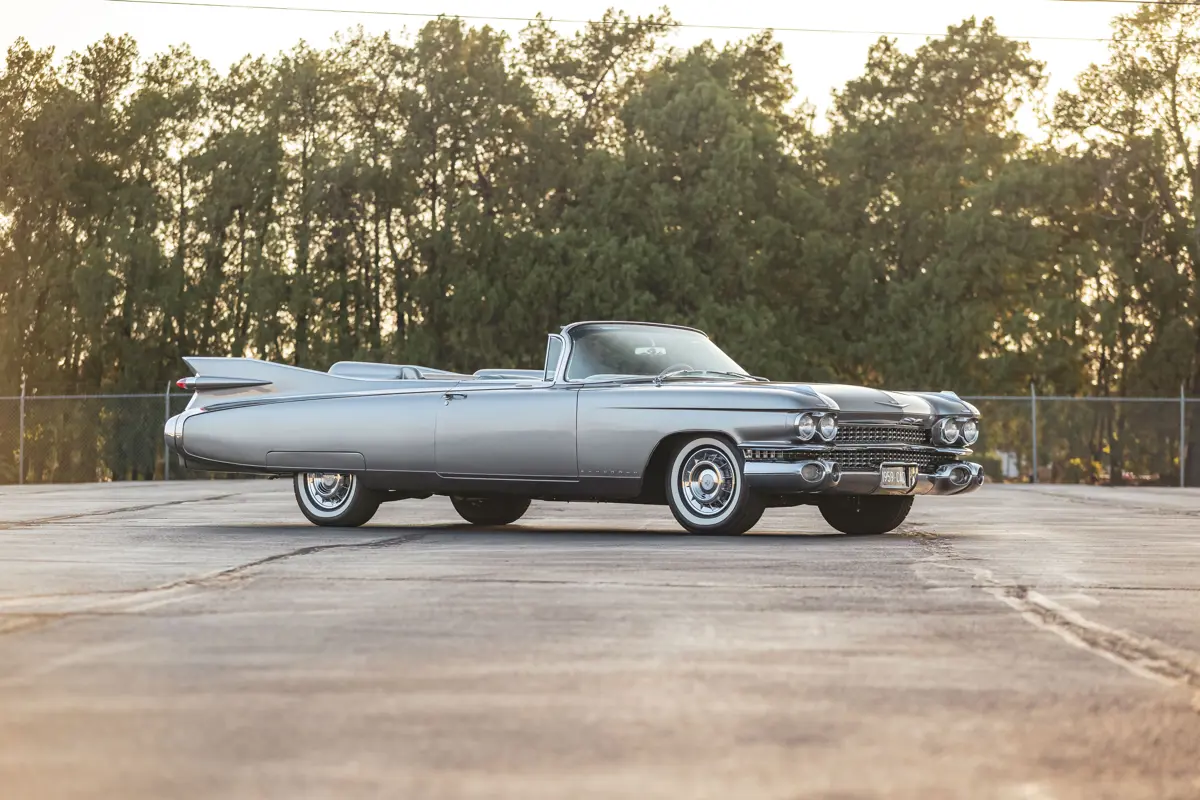
The 1959 Cadillac that eventually emerged belongs to the transition between Harley Earl and Bill Mitchell, but the famous fin treatment can be attributed much more directly. Dave Holls produced the original sketch for the ’59 fin, while Chuck Jordan became head of Cadillac’s design studio in October 1957, by which point he later recalled that the basic 1959 car was already close to completion.
What reached showrooms was impossible to mistake for anything else. The new Cadillac was lower and wider, with a vast glass area, a broad grille, and twin-bullet rear lamps set into what became the largest fins fitted to an American production car. The Hershey Eldorado Biarritz used Cadillac’s enlarged 390 cubic-inch V-8 with three two-barrel carburetors for 345 horsepower. Only 1,320 Biarritz convertibles were built that year.
By then, the Eldorado had become useful shorthand for success in post-war America. Dwight Eisenhower rode in a white 1953 Eldorado during his January 1953 inaugural parade. Elvis Presley bought a white 1956 Eldorado Biarritz and had it repainted a vivid grape color. Frank Sinatra and Bob Hope were among the buyers of Eldorado Broughams, and a 1956 Biarritz even appears at the end of The Solid Gold Cadillac, with the otherwise black-and-white film switching to color for its final Cadillac shots.
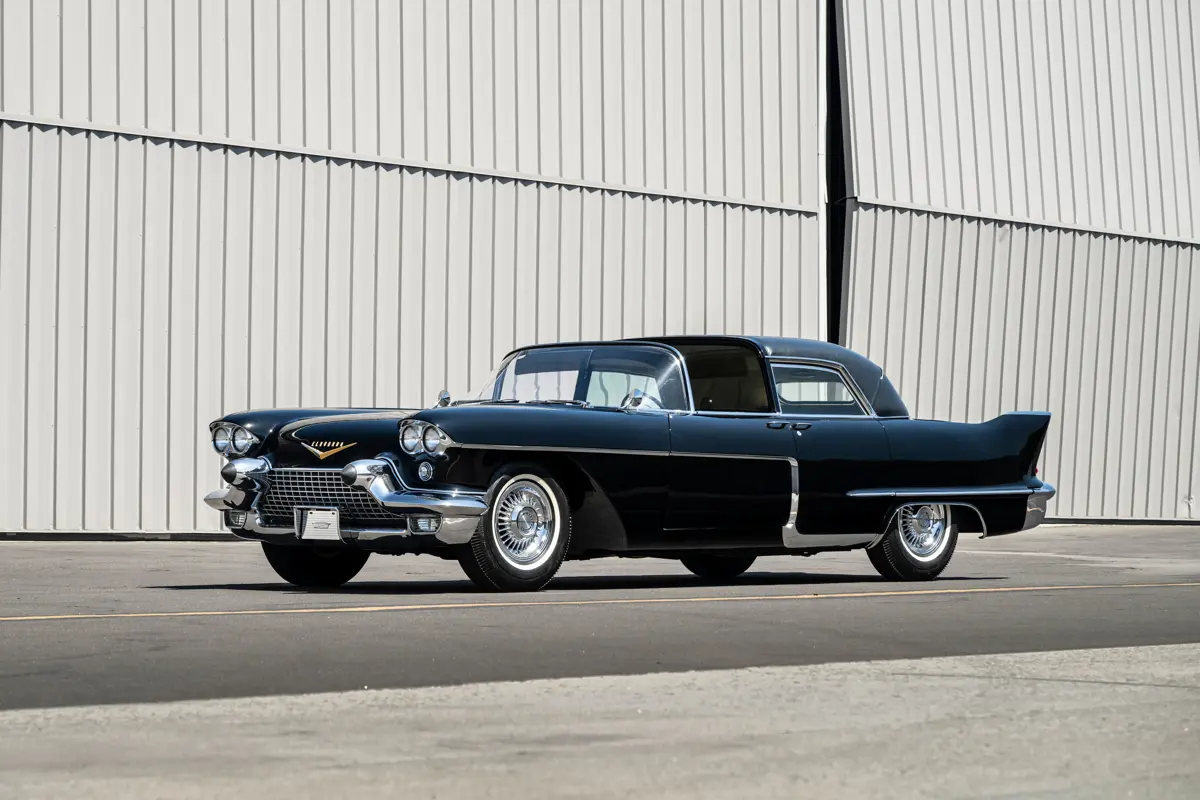
Those associations make sense when you look at the cars. Through the 1950s, the Eldorado caught Cadillac at its most confident, with enough price and prestige to justify technology and styling that would have been harder to sell farther down the range.
Few cars chart the decade as completely as the Eldorado. In six years, the Eldorado went from a low-production convertible with a wraparound windscreen to a 345-horsepower Biarritz wearing the biggest fins Cadillac ever put into production, with the Brougham’s air suspension, memory seat and stainless-steel roof appearing in between. As a record of what happened to American car design during the 1950s, it takes some beating.